
Will The Ballad of Narayama make you cry?
Harsh for most of its length and then very sad at the end: that is the shape of The Ballad of Narayama. Shohei Imamura's 1983 film is set in a poor mountain village in 19th-century Japan where custom says anyone who reaches 70 must be taken up the mountain and left to die. Orin is 69, healthy and determined to go on time, and she spends her last year putting her family in order.
Read the full write-up on The Ballad of Narayama💧
No stories yet
Be the first to share how this movie made you feel.
How sad is The Ballad of Narayama and will it make you cry?
Harsh for most of its length and then very sad at the end: that is the shape of The Ballad of Narayama. Shohei Imamura's 1983 film is set in a poor mountain village in 19th-century Japan where custom says anyone who reaches 70 must be taken up the mountain and left to die. Orin is 69, healthy and determined to go on time, and she spends her last year putting her family in order.
Most of it is blunt and earthy, and you will wince more often than you well up. Hunger, sex, punishment and animals all get the same flat stare, and some of it is hard to watch. The grief arrives late, in a long and nearly wordless sequence between a mother and her son. It lands hardest on people caring for an elderly parent, and on anyone who has had to carry out a wish they did not agree with.
Potential spoilers below
The following sections may reveal plot details.
Potential Soft Spots
- Caring for a parent near the end of their life
- An elderly relative who insists on not being a burden
- Being asked to go along with a death you are not ready for
- Growing up somewhere food was counted
- A goodbye where you were not allowed to say anything
The Scenes That Get People
- The teeth. In her village a full set of teeth at 69 is something to be ashamed of. Orin knocks hers out against stone.
- The burial. A family caught stealing food is seized at night and buried alive by the rest of the village.
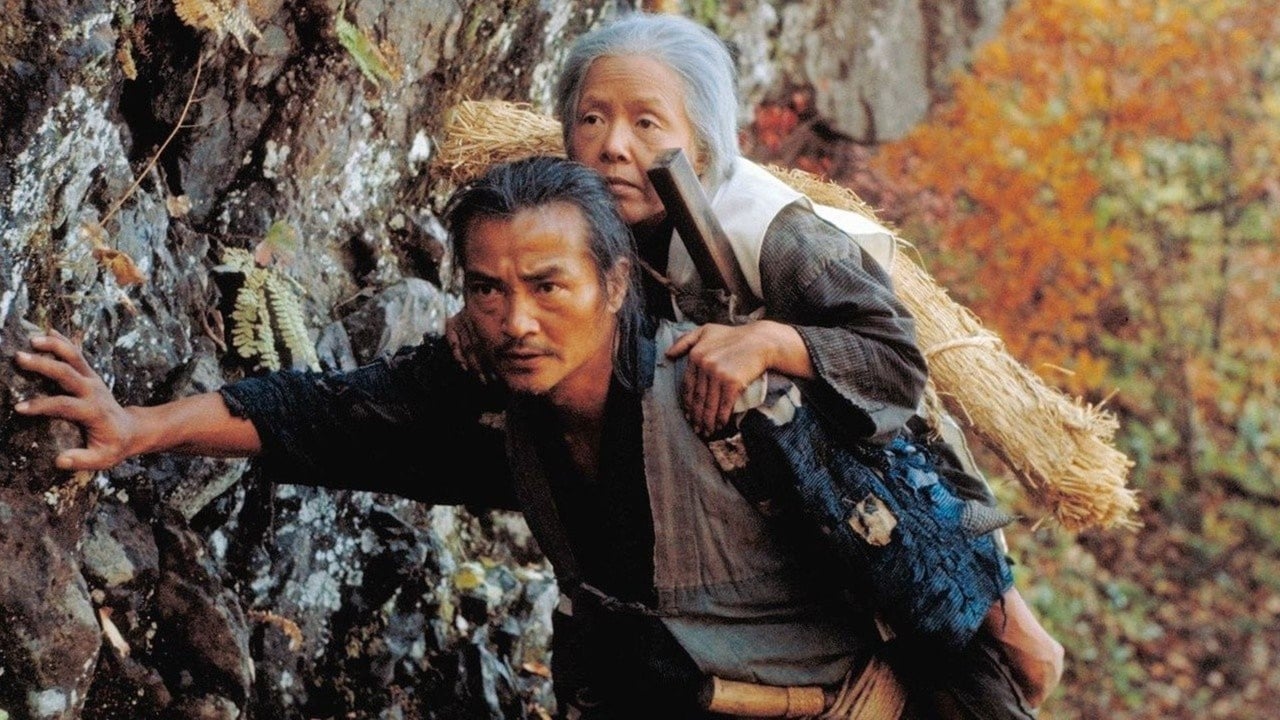
- The climb. Tatsuhei carries his mother up Narayama on his back, past the bones of those taken before and the crows that feed there. Neither is supposed to speak. She sends him away.
- Matayan. On the way down Tatsuhei sees a neighbour throw his own father, who did not want to go, into a ravine.
- The snow. Orin had hoped for snow on the day she left. It starts to fall, and Tatsuhei breaks the rule and calls out to tell her.
Behind the Scenes & Cultural Impact
- It adapts Shichirō Fukazawa's story of the same name, which Keisuke Kinoshita had already filmed in 1958. Wikipedia
- The story was Fukazawa's literary debut, published in the magazine Chūō Kōron in November 1956, when he was 42. Wikipedia
- Imamura's film won the Palme d'Or at Cannes in 1983, and Ken Ogata won Best Actor at the Japan Academy Film Prize for playing Tatsuhei. Wikipedia
Frequently Asked Questions
Is The Ballad of Narayama sad?
Yes, mostly in its last stretch, when Tatsuhei carries his mother up the mountain to leave her there. Before that it is a rough, unsentimental picture of village life that shocks more often than it saddens.
Does The Ballad of Narayama have a happy ending?
No. Orin is left on the mountain to die, as custom demands. The snow she hoped for begins to fall, so she gets the death she wanted, and her son goes home without her.
Is The Ballad of Narayama based on a true story?
No. It is based on a 1956 short story by Shichirō Fukazawa. Ubasute, the abandoning of old people on a mountain, is a practice from Japanese legend.
Is the 1983 Ballad of Narayama a remake?
It is a second adaptation of the same story. Keisuke Kinoshita directed the first film version in 1958, and Shohei Imamura made this one in 1983.
The Ballad of Narayama is on these lists
More Sad Movies Like The Ballad of Narayama

Seen it? Rate it
Still Walking (2008)💧2.0/5(1)
Seen it? Rate it

Seen it? Rate it
Drawing Closer (2024)💧3.6/5(5)
Seen it? Rate it
Ride Your Wave (2019)💧4.0/5(1)
Seen it? Rate it
Grave of the Fireflies (1988)💧4.3/5(12)
Seen it? Rate it
My Tomorrow, Your Yesterday (2016)💧2.0/5(1)
Seen it? Rate it
Close (2022)💧—/5- Suggest a Movie